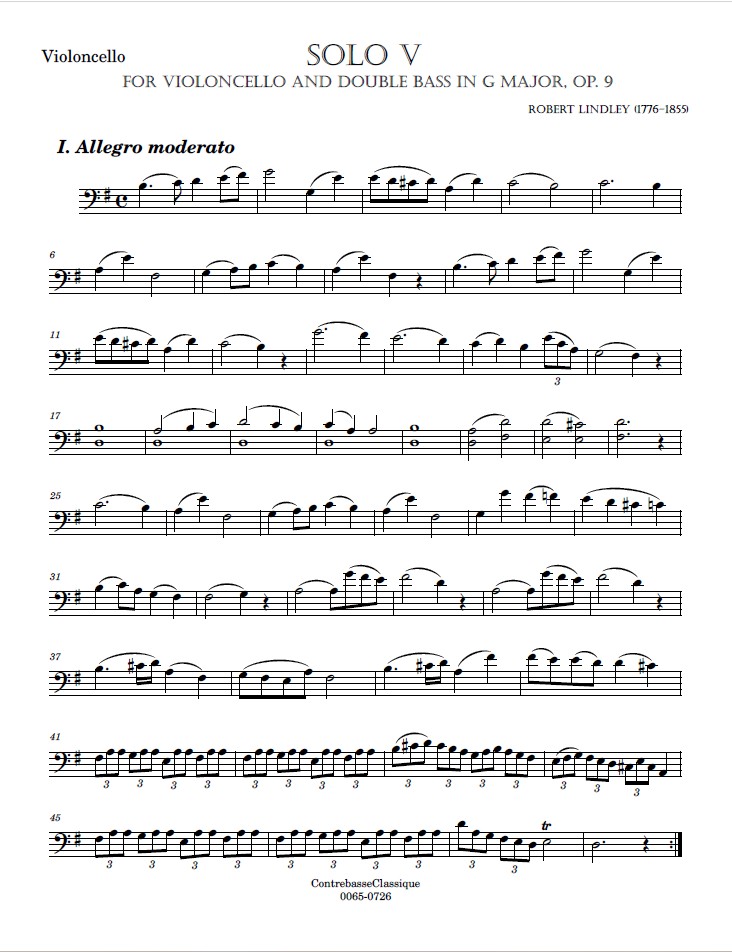
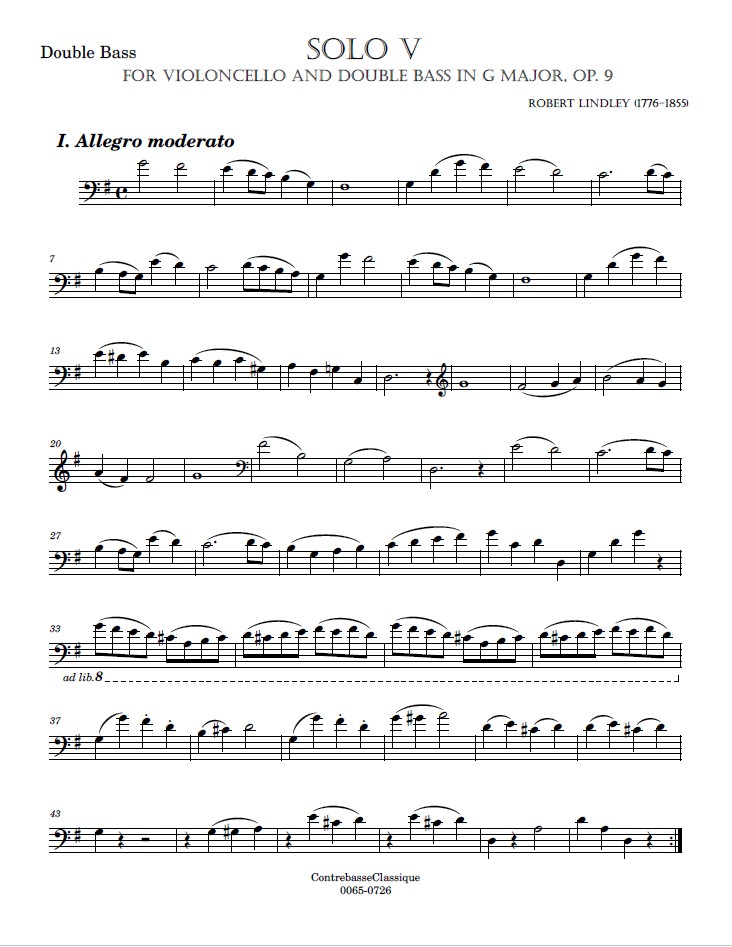
Description
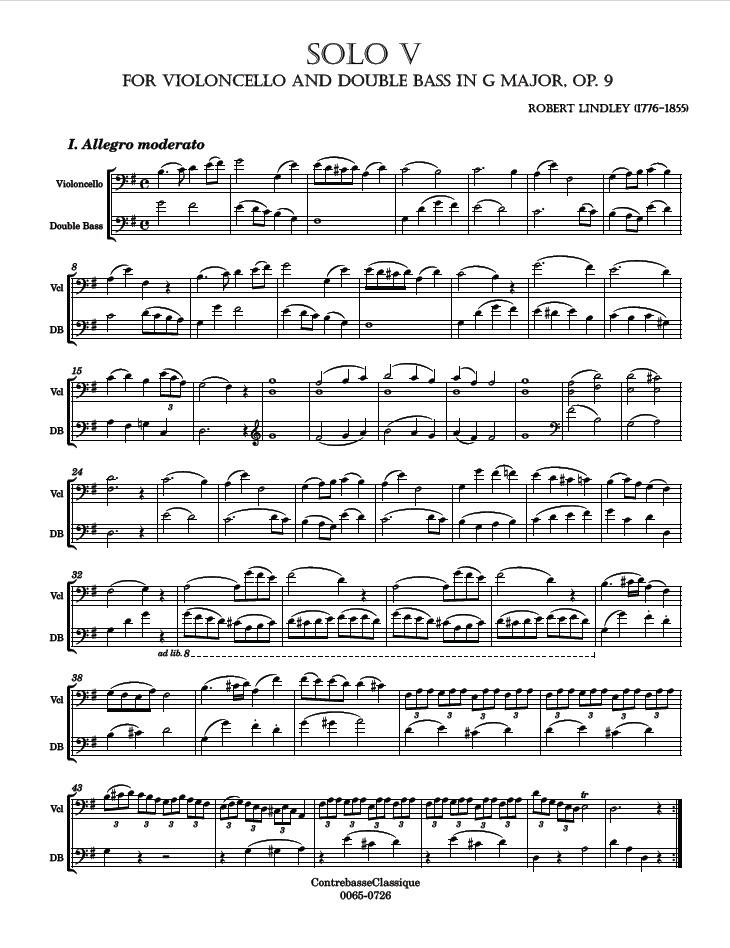
Solo V, op. 9
Classical Duet (year unknown)
Product details:
- Composer: LINDLEY, Robert (1776-1855)
- Format: high-resolution digital PDF (printable)
- Instrumentation: violoncello and double bass
- Number of pages (score): 5
- Number of movements: 2
- Special features of this score: Robert Lindley was one of the most celebrated cellists of the late Classical and early Romantic periods and is often regarded as the founder of the English school of cello playing. He was born in 1776 in Rotherham, England, studied first with his father and later with the distinguished cellist James Cervetto, who recognized his exceptional talent and taught him free of charge. At only eighteen years old, Lindley became principal cellist of the Italian Opera in London, a position he retained for more than half a century, until 1851. His contemporaries admired his rich tone, extraordinary technical facility, and above all his skill as an accompanist in opera, where he improvised continuo accompaniments of remarkable sophistication.In 1822, Lindley became one of the first professors at the newly founded Royal Academy of Music, where he taught an entire generation of British cellists. Although he composed extensively—four cello concertos, numerous duos, solos, studies, and chamber works—his reputation has always rested primarily on his playing rather than his compositions.An important aspect of his career was his lifelong collaboration with Domenico Dragonetti. The two musicians played together for decades at the opera and in London’s major concert organizations. Their partnership became legendary, with many accounts emphasizing the remarkable power and artistry of their combined cello and double bass sound. Contemporary accounts describe Lindley as perhaps the finest cellist of his generation, while Dragonetti revolutionized the status of the double bass as a solo instrument.
The Six Solos for Violoncello and Bass, Op. 9 are among Lindley’s most important surviving compositions. They were probably written around the first decade of the nineteenth century, although no exact date of composition has been established. The surviving edition was published in Paris by Frey and bears the plate number 547, but no publication year is indicated. The title page reads: Six Solos pour Violoncelle et Basse. The “basse” part is an unfigured continuo line, functioning essentially as a second cello part or a bass accompaniment. The works can therefore be performed by two cellos, or by a cello with another bass instrument. The Six Solos offer the opportunity to effectively enter the musical world in which Dragonetti himself performed. Few chamber works allow such direct contact with the performance practice of the late Classical and early Romantic periods. They are firmly rooted in the Classical tradition, stylistically closer to the music of late eighteenth-century virtuoso composers than to the Romantic cello literature that would emerge later.
From a cellist’s perspective, the Six Solos are historically fascinating because they document the technical level attained by one of the greatest virtuosi of his era. These works occupy a stylistic position between the sonatas and concertos of Luigi Boccherini and the more virtuosic nineteenth-century repertoire of Bernhard Romberg. Despite Lindley’s immense fame during his lifetime, the Six Solos virtually disappeared from the standard repertoire because of the following reasons: His reputation as a performer overshadowed his compositions; the works were published only in limited editions; the rise of Romantic cello repertoire pushed much Classical British music into obscurity; few twentieth-century cellists championed his music. In recent decades, however, there has been renewed interest in Lindley’s works as musicians and scholars have rediscovered the rich British cello tradition of the late eighteenth and early nineteenth centuries.
Why choose this score?
- A unique work in the chamber music repertoire
- Clear, readable file, ready to print or use on a tablet
- Immediately available after purchase